
While caring for our son, we had a lot of experience with the various modes of transportation for the disabled and encountered issues and difficulties.
Cars, taxis, Uber
In his book, “Never Say Invisible” (https://www.neversayinvisible.com/book/; published posthumously) our son talked about the discrimination and difficulties he experienced when he needed a taxi or an Uber while he was still on crutches, or a walker, or had a rented 3- or 4-wheeled scooter. Some taxi and Uber drivers wouldn’t stop to pick him up when they saw him; some drivers actually got out of their cars and assisted him, some drivers just sat there waiting for him to figure out how to get in or out. He had to get into the vehicles by backing in while holding on to the door or door frame until he could sit, then pivoting to face forward, then swinging his legs in. Sometimes he realized that he couldn’t get into the vehicle at all because of the design or height.
Very early in our son’s illness, we only owned passenger sedans to take him places. Our son was able to sit in the car (usually the front passenger seat), but it was difficult getting him in and out. We usually rolled his push wheelchair to the right side of the car and placed him parallel to, and very close to, the opened door on the passenger side of the car, then locked the two brakes on his chair. I then leaned way into him until we were cheek to cheek, wrapped my arms around his waist like a bear hug, lowered my butt to keep my center of gravity as low as possible, slid him forward as best as possible, stood him up, and pivoted him so his butt was facing the seat. To steady himself, he (or I) placed his hand on the top of the door frame, or sometimes I lowered the window so he (or I) could place his hand on the window sill. Then, while still hugging him, I slowly lowered him into the seat. I then lifted his feet, pivoted him and his legs into the car, finally placed his feet on the floor, and strapped him in. When I had to get him out of the car, the procedure was reversed. My wife usually stood behind him as much as possible with her hand against him for support so he wouldn’t fall backwards.
Accessible vans
When our son got his 450 pound power wheelchair, we had to get an accessible van. A brand new accessible van is beautiful and has all the bells and whistles, but is very expensive, so there is a big demand for used ones. Regular minivans can be converted after-market. I think SUV’s are not roomy enough. I would recommend either getting a minivan and bringing it to a place that converts them if you have the time, or getting an already-converted van from a dealer that sells accessible vans. I would not recommend buying a used converted van from a used-car dealer that just so happens to have one on his lot because the service department (if there even is one) might not know how to service it. Having a van converted or buying a converted van from a place that converts them will facilitate getting any specialized repair services when needed. Of course, if you can get a full-sized van, then space is no issue.
Consider the pros and cons of side-entry vs rear-entry. Regardless of the version, you lose seats to make way for the powerchair. The rear entry van: Rear entry means you need a clear area behind the van when you’ve parked for entry and exit. Where will the patient dock the powerchair? It’s a bumpier ride back there unless the chair can be positioned in the middle row of the van, but then you’ll lose a lot of seating area because you need a clear path from the rear entry to the middle. You might lose luggage storage space in the back to make way for the powerchair. (We have no experience with a rear-entry van.)
We used a dealer in Fairfield, NJ (https://drivemastermobility.com). Our son bought a Dodge Caravan (see photo below) with a side-entry, manually-operated ramp, so that’s the only one we used. (I should have titled the van in my name to avoid the probate problems that arose after his passing, but I didn’t think of that). We had an inverter installed under the driver’s seat that had two 110-volt receptacles for all the ALS-related equipment (cough assist, suction device, nebulizer, and ventilator) and other contingencies. This was very handy. The passenger seat was removable, even though it was very difficult to do. The back bench was not removable and there was no middle seat. There was a fairly decent amount of luggage space. The van we bought for $38,000 in 2018 was then about 5 years old, it had had 2 previous owners, and it had only about 12,000 miles on it. The van was noisy, clunky and clumsy to drive. In addition to buying insurance on the van itself, I had to buy extra car insurance that covered just the conversion features because my car insurance policy wouldn’t cover any damage to the ramp and other features. Worse yet, Dodge wouldn’t service the conversion features, so I always had to use two places for servicing.
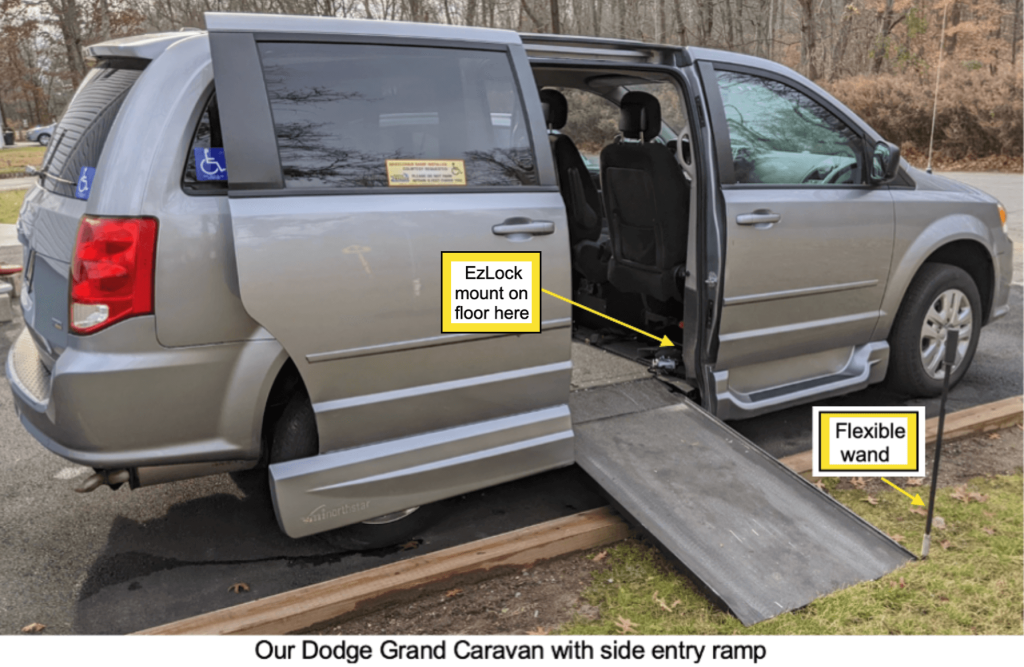
Regarding the ramp itself: we were lucky that the ramp in our van was completely concealed under the floor when not in use. It was very easy to move the ramp in and out with the flexible wand. (See photo above). The only downside to the ramp design was that it rattled very loudly while we were in motion. I think the ramp sometimes got wet when it was raining and we were moving. There was a musty odor when we first got the van, possibly from mold in the ramp compartment, but the odor eventually disappeared.
There are other ramp versions. The ramp in my father-in-law’s van many years ago was stored by just tilting it up and sliding the door closed, so the ramp sat just inside the sliding door and right behind the passenger seat. The folded ramp blocked the ability of anyone to exit that door unless the ramp was opened up and lowered to the ground. The stored ramp also prevented the passenger seat from reclining or sliding back for comfort. The ramp also blocked the view out the sliding door’s window. Other ramp versions are stored by first folding the ramp in half, but they still prevent movement of the passenger seat. Some vans have motorized ramps or motorized lift platforms and should have manual overrides in case of motor failure.
Getting the handicapped person in and out of an accessible van will also be dictated by the ramp’s location, floor space, and locations of the seats.
EZ-Lock in the driver’s position
An acquaintance of mine who has multiple sclerosis has the same powerchair our son did. He is fully capable of controlling his powerchair without assistance. He is also fully capable of driving his accessible van. He had the original driver’s seat removed and an EZ-Lock plate (discussed in great detail in the next section) placed where the driver’s seat was. I saw him easily drive up the side-entry ramp and dock to the EZ-lock plate. See Route “A” in the image of our actual van below.
Exiting the van was also a challenge. Our son eventually lost all ability to operate his powerchair, so I usually had to drive him into and out of the van while standing behind him and while using the rear controller. It was very clumsy and I had to keep my eyes at all times on the front left corner of his powerchair to make sure I remained centered on the ramp while exiting. I usually hit my head on the ceiling when doing this. When our son was still trying to drive the powerchair himself, he almost drove the powerchair off the side of the ramp on four separate occasions. I’ll describe these below.
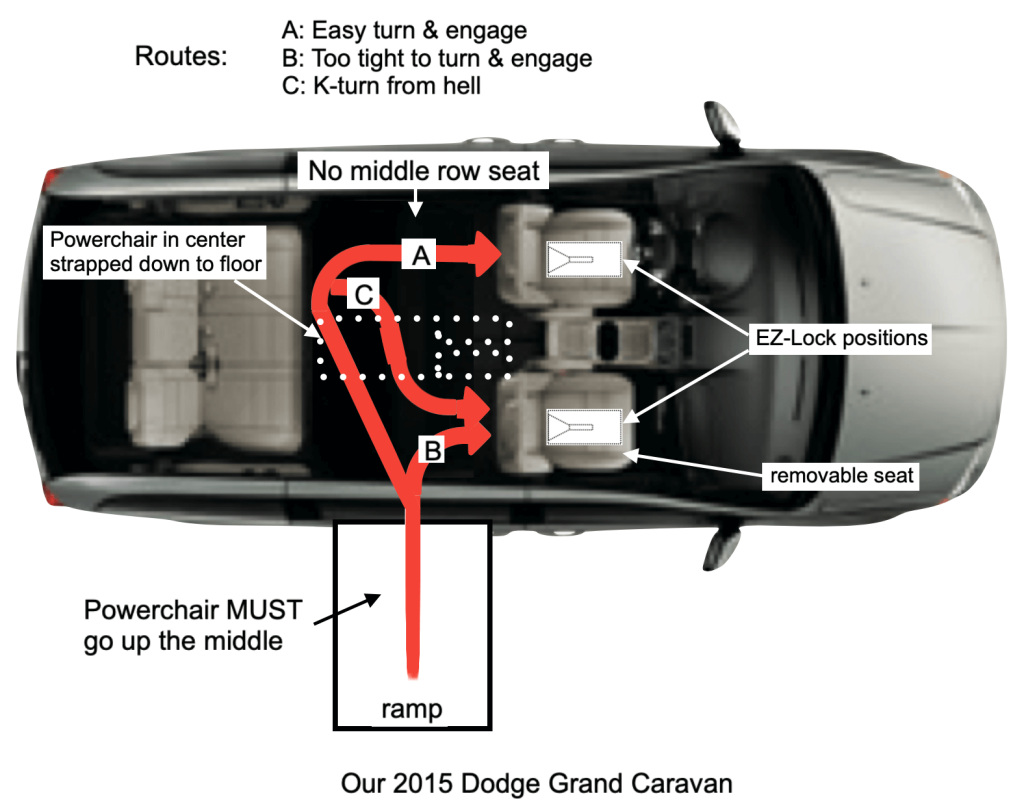
EZ-Lock in the front passenger’s position
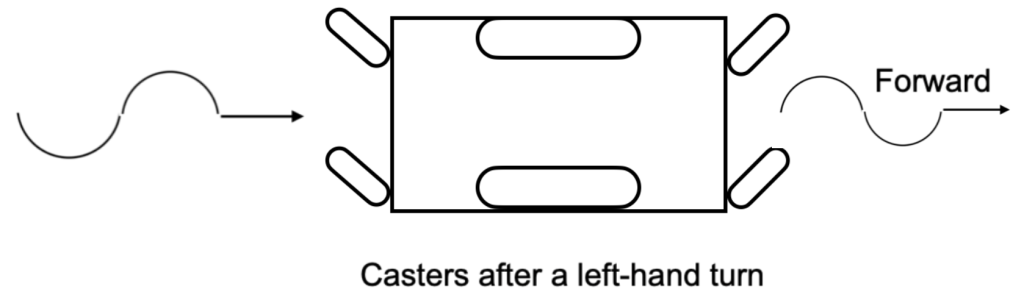
Our son’s van had an EZ-Lock plate mounted under the front passenger seat. I had to remove the passenger seat whenever I wanted to take my son somewhere and he wanted to sit next to me. Early in his diagnosis, his hands were very weak, but he was still able to drive his own powerchair (with difficulty). He always had a very difficult time driving up the middle of the ramp, turning sharp right, and trying to engage the EZ-Lock plate. (See Route B in the image above). I think the primary reason for the difficulty was caused by the center-drive, 6-wheel configuration on his powerchair: the front casters always required 3 – 4 feet of straight-line driving after a turn to aim the casters forward. (See image below: the left- and right-curved lines show the paths that the rear and front ends of the chair followed as he tried to straighten out.) Obviously, there was no room in the tight confines in the middle of the van, so the powerchair over-steered and he could never engage the EZ-Lock straight on.
The only option was Route C (two images above), which was sort-of a K-turn from Hell. He drove up the middle of the ramp, then drove to the left past the front passenger seat, then turned 180° to the right. The back bench made for a tight space. His two footrests (see dotted figure two images above) almost always gouged or collided with the back of the driver’s seat while he was turning. He then had to turn 90° to the left as he approached the EZ-Lock plate, and hoped he engaged it. He rarely, if ever, engaged the plate straight on because of over-steering.
Our son’s powerchair (and even a push wheelchair) had to be locked down to the floor while in motion. Our son’s empty power chair weighed 450 pounds and with him in it, 585 pounds. I once or twice had to take it for servicing and just placed it behind me unsecured because I figured the weight would keep it in place. As I was driving, I saw it move and bounce around every time I went over a bump, and trying to hold it steady while driving was useless. Lesson learned.
Securing the powerchair to the floor
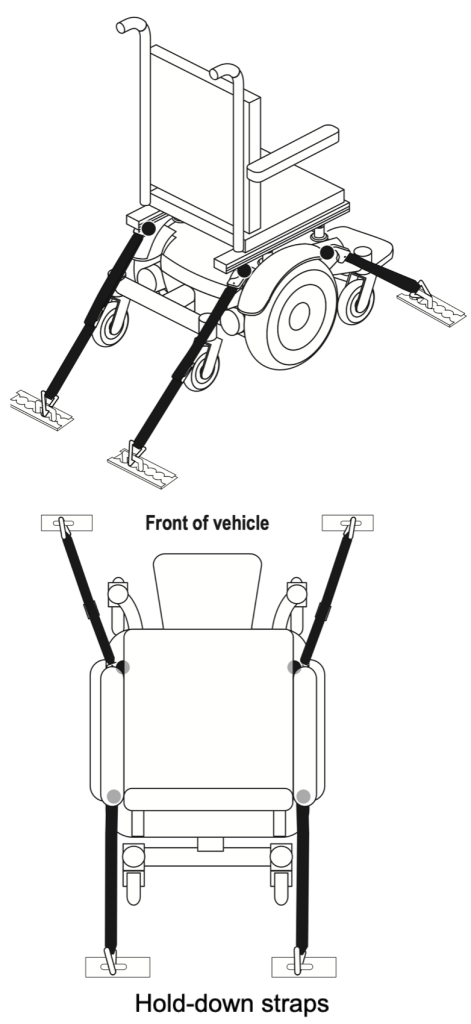
We had two ways of locking the chair down to the floor. The first way: The van came with 4 adjustable ratcheted hold-down straps and hooks that attached his chair securely to tracks in the floor. (See diagram below.) The tracks were in both the front passenger position and along the whole middle of the van where the second-row seat used to be. This way, our son could either sit next to the driver or park his chair in the middle of the van and face forward between the driver and front passenger. However, if there were an erratic maneuver, like a swerve, or accident, or even an overturn, I think the straps would not have been sufficient to keep the chair in position.
The second way we locked out son’s chair to the floor (only in the front passenger area) was with an EZ-Lock docking device (https://www.ezlock.net ) that was mounted on the floor at the front passenger area. See photo below.

The EZ-Lock consisted of three parts: an electronic device with alarm mounted on the dashboard (not shown), a docking base bolted to the floor (photo above; diagram below), and a massive bolt (drop pin) attached to the underside of the wheelchair. (See diagram below.)
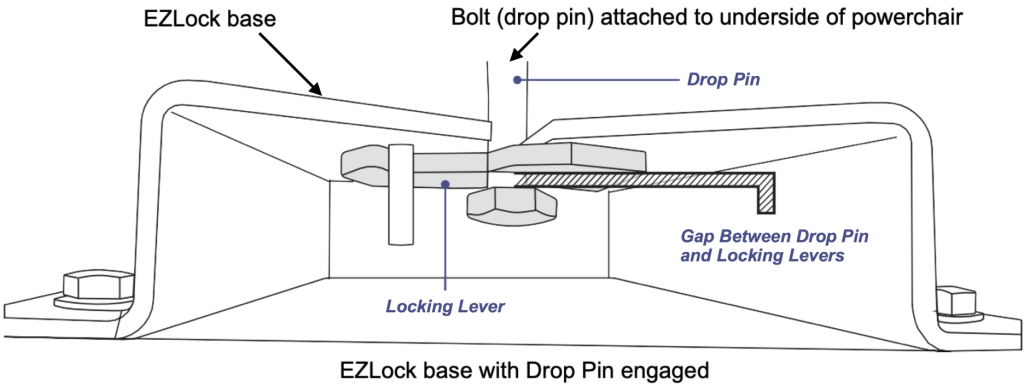
The van could not be started, even without a wheelchair in the car until the alarm override button was pressed. The alarm was ear-piercing. The wheelchair was driven up the ramp into the van, then a fancy and difficult sharp righthand turn was made and then the chair was driven forward until the bolt entered the V-shaped slot in the base, then engaged the slot, and then the locking mechanism. Almost every time we tried to engage the EZ-lock bolt under the powerchair with the EZ-Lock, the powerchair lurched forward violently because it was never easy to align the bolt and the slot. This was always difficult for both my son and me. I’ve heard that the EZ-Lock supposedly would have held the chair against the floor even if the van flipped over, obviously with the patient dangling upside down. Maybe the EZLock would have been better if it were mounted in the center of the middle row (not the front passenger position), but the powerchair would then have to be docked facing the side of the van. Eventually, we stopped using the EZ-Lock and always parked our son’s chair in the middle row of the van with the hold-down straps. I would not get an EZ-Lock if I had to do it again.
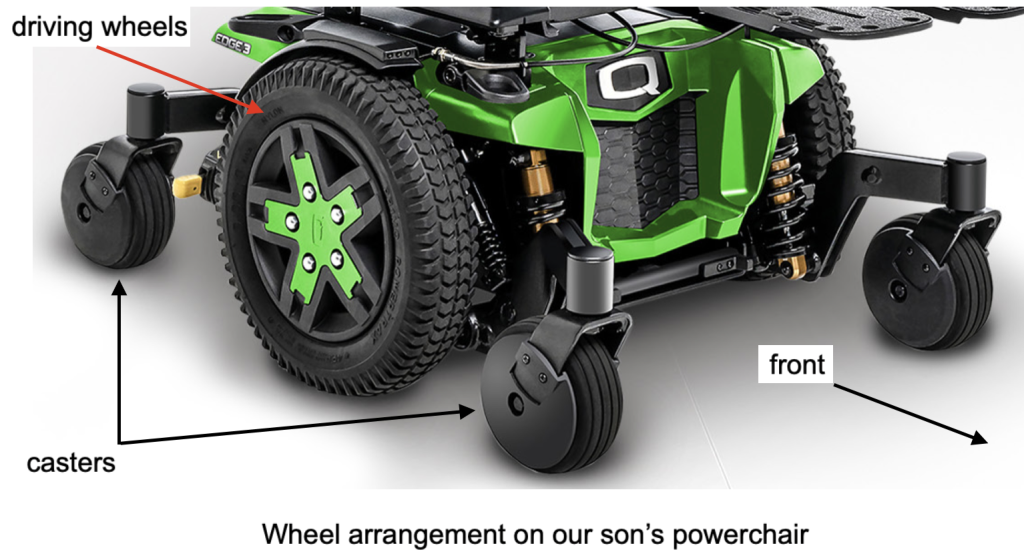
I think the very difficult time we all had engaging the EZ-Lock docking base was due to the 6-wheel configuration of the chair (2 front and 2 rear casters and 2 middle driving wheels). Our son had a Quantum Edge 3 chair (https://www.quantumrehab.com/quantum-power-bases/edge-3.asp). (See photo below.) The configuration of wheels enabled him to turn on a dime (mind you, a very large dime). However, the major problem with this design occurred whenever he reversed direction (in either direction). Both pairs of casters had to swivel completely around on their vertical posts 180 degrees. The reversal forced both pairs of casters to misalign or oversteer with respect to the direction he was heading, so the chair had to travel maybe 2 – 3 feet (if there was room) to straighten out. Getting in and out of, and maneuvering in, the narrow confines of our side-entry handicap van was always tricky because of the oversteering.
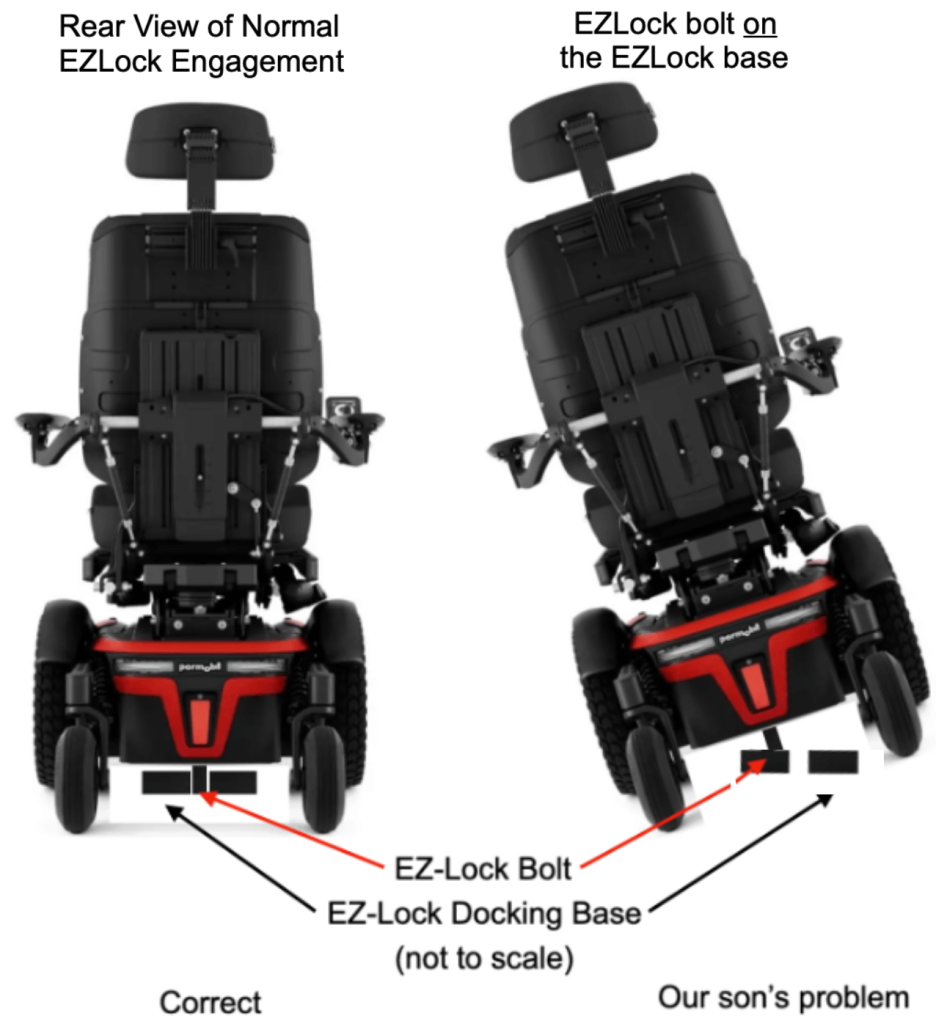
One rainy dark night my son, my wife and I had visited friends. When we were leaving, our son drove up the van’s ramp and tried to engage the slot in the EZ-Lock docking base but approached it way off-center; the chair missed the slot. The bolt (drop pin) was on the base and tilted the chair so the right-side wheels (and maybe some of the left-side wheels) were in the air. Because of the 580 pounds of the chair plus our son, it took four men about an hour to move the chair off the docking base and engage correctly.
Towing a trailer with a Power Wheel Chair (PWC)
If you want to tow a trailer with a power chair in it, make sure you secure the PWC to the trailer floor and center it!!! If the trailer has only one axle or two clustered towards the back, find out where the PWC is best placed (over the axle(s), or forward of the axle(s), etc?). Be careful of fishtailing (I don’t know what causes fishtailing, but it can throw the chair around). You don’t want the PWC to shift around in the trailer while you’re in motion or if you have to stop suddenly.
Note: Getting a trailer for a powerchair is obviously much cheaper than getting a new or used accessible van. I do not recommend a trailer. Early in the disease, the ALS sufferer can probably still sit up in one of the seats in a vehicle. Since ALS is a progressive disease (it only gets worse), a trailer could only be a short-term solution to traveling with a patient with his or her powerchair because eventually the ALS sufferer will have to remain in a powerchair while traveling. So, save a step and look for an accessible van sooner than later.
Parking
Do you know what a striped area next to a handicapped parking spot is for? (See photo below). Sometimes the signs only say “Van accessible”, but that doesn’t tell a driver why. It’s for exiting or entering a van with a side-entry ramp.
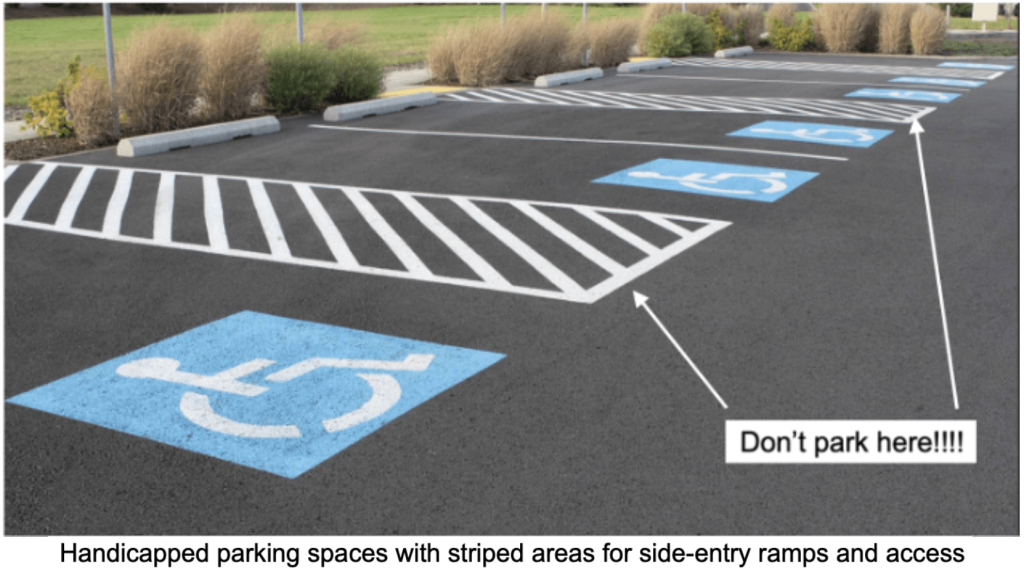
With a side-entry ramp, you either have to park in a designated blue parking zone with the striped area on the passenger side to allow you to pull out the ramp, or you have to park next to any available area so you can lower the ramp. Idiots inevitably park on the stripes. If there are no handicapped parking spots left, position the van as in the drawing below: partly pull into the spot so there is clearance for the side-entry ramp to be lowered behind the car to your right, get the patient in or out of the van, then close up the ramp and pull in. With a rear-entrance van, you have to unload and load directly into the parking lot (dangerous), unless you can back up to a safe area.
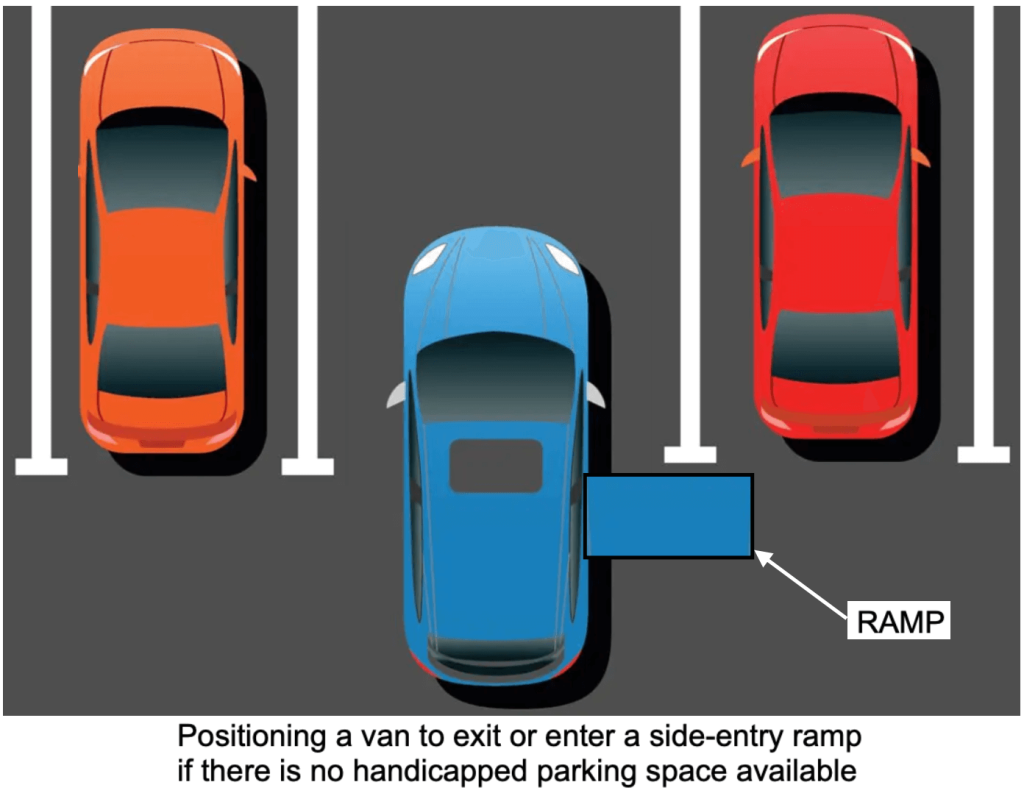
(Adapted from https://www.istockphoto.com/vector/crowded-car-parking-gm486894514-73788947)
Driving off the side of the ramp
On four separate occasions, we had some scares when our son tried to drive himself out of the van and down the ramp. The sides of the ramp had one-inch-high lips that were not deterrents. On all four occasions, the front left caster went over the left lip and off the side of the ramp because of the oversteering I mentioned earlier. In the first of these occasions, he was almost at the very bottom of the ramp, so he drove over the ramp’s wand and snapped it clean off, but he was safe. (I had to bring the van in to have the new wand and mounting hardware installed ($100)). On a second occasion, our son was again almost at the bottom of the ramp when the same left front caster went off the side, so he stopped while I unscrewed the manual wand from its mount, then he continued with only 5 wheels on the ramp until he was on the ground. Safe again.
In the third, and scariest incident, my son and I had just returned from a doctor’s appointment. We were in our driveway and our son began exiting the van by himself in his chair. He was still at the very top of the ramp when the same front left caster went off the side due to oversteering. See photo below.
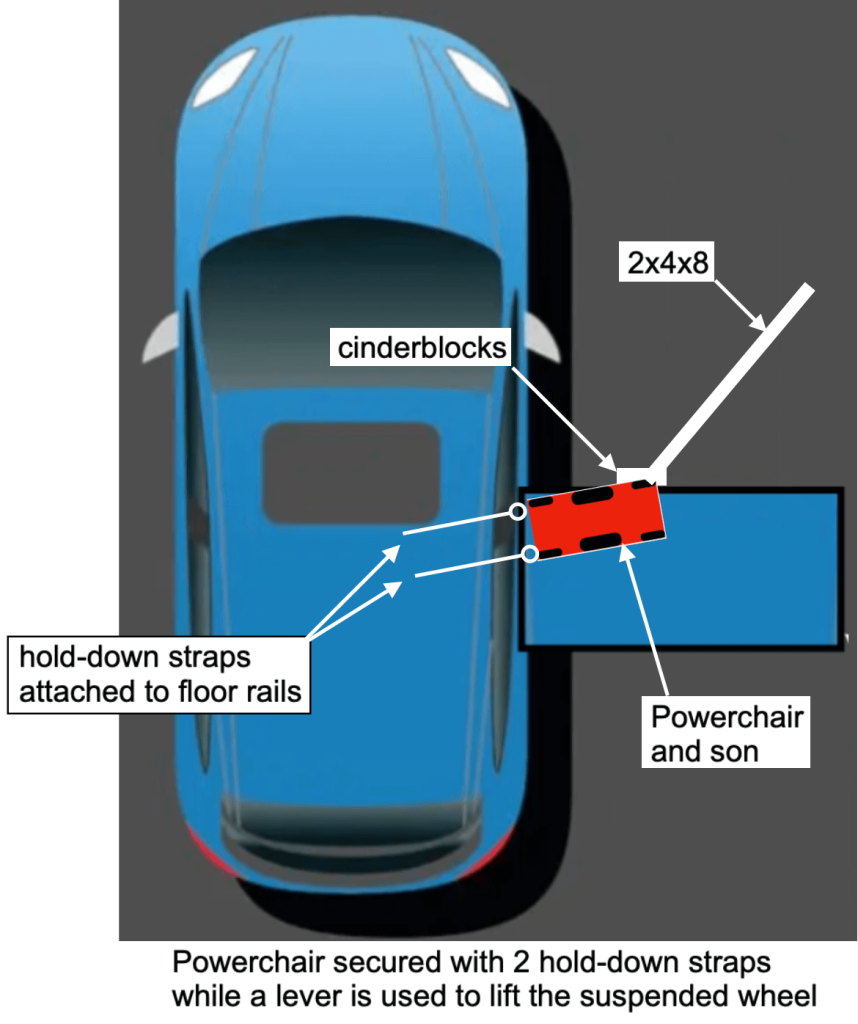
He was stuck there, and because he still had some speaking ability, he began screaming and panicking. He could not go forward because he would drive off the ramp. He tried to back up the ramp a little but the left caster would not go back over the lip onto the ramp. The chair was so heavy that I could not manually lift the caster back onto the ramp to reposition the chair. Our son calmed down and thought of an excellent idea for me to secure him until I could reposition him.
To prevent the chair from moving further down the ramp or toppling off the side, I first shut off the chair, but kept the drives engaged so the chair could not roll. I connected the ends of two of the van’s hold-down straps to the floor and the other two ends of the straps to the strong steel eyelets at the back of his chair frame and tightened the ratchets. Now he wasn’t going anywhere. I got some cinderblocks and a 2 x 4 x 8 piece of lumber. I placed the cinderblocks on the driveway directly under the dangling left caster for support. I then turned on the chair’s drive, then disengaged the two motor brakes on his chair so the chair could roll, (but it couldn’t move because the chair was held securely by the two hold-down straps). I then used the 2 x 4 x 8 as a giant lever on the cinderblock and under the caster’s arm (not under the caster itself). By using all my strength to force the 2 x 4 upwards, I lifted the dangling corner of the powerchair back onto the ramp. I then reengaged the motor brakes, unhooked the straps, backed the chair up the ramp a little, straightened it out, then drove the chair down the ramp. I guess I could have called the fire department. Very scary.
The fourth incident was a repeat of the third one, but our son was further down the ramp so he was able to continue to the ground after I removed the ramp’s wand again, even though the same left caster was dangling.
From that point on, we operated his chair. It was still very difficult for us. To exit the van, I had to stand behind his chair and drive it with the rear joystick. After a road trip, and after removing the straps, I had to back the chair up a few inches, make a sharp right turn to face the ramp, and most importantly, I had to have a direct line of sight to the left caster at all times while I drove very slowly down the ramp with the rear controller. It also helped to have a second person at the bottom of the ramp directing me.
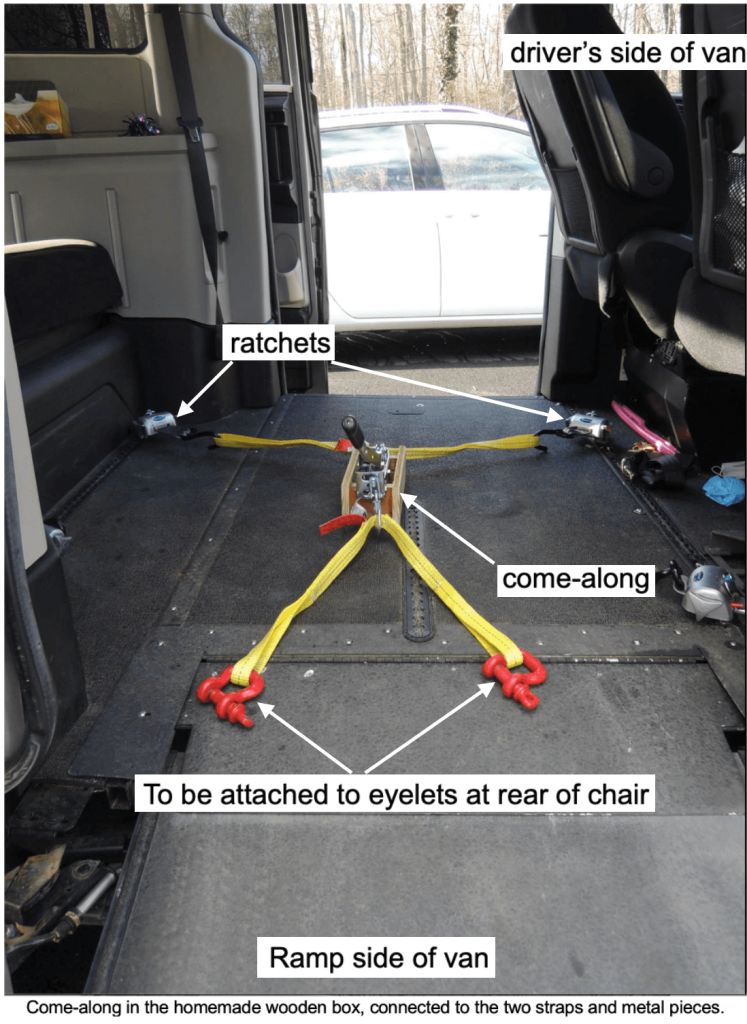
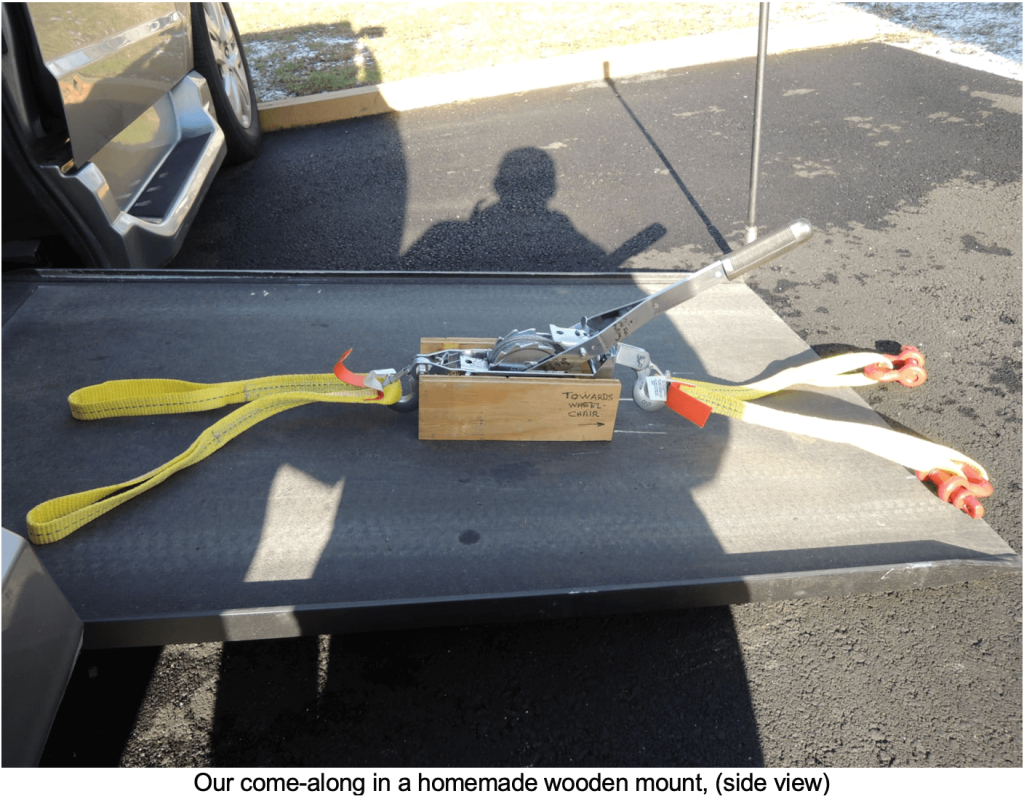
Figuring that this problem would happen again somewhere away from home, I knew I needed some equipment to keep in the van. Our son told me about a device called a “come-along” (a ratcheting device) which I had never heard of. Here is a link to some on Amazon: https://www.amazon.com/Come-Along-Tool/s?k=Come+Along+Tool). I bought one, plus some straps and hooks (all rated to 1000 pounds) and rigged them up as in the photos below. I built a small wooden box for the come-along so it would keep the come-along upright on the van floor if I had to use it. Fortunately, I never had to use the come-along, but I was great knowing it was in the van.
Trains
I took our son to New York City by myself once for his doctor’s appointment when he was still in a push wheelchair. I had to stand at the designated area of the train platform so the engineer would see us and stop at the correct position. A conductor laid a metal ramp over the gap between the platform and the train so my son could roll onto the train. Getting out of the train in NYC required assistance, too. Getting out of Penn Station was complicated, but an employee helped us. The second time our son, my wife and I wanted to go to NY City, we followed the same routine at the start of the trip, but an announcement the last minute stated that the train was arriving on a different platform. We rushed back down to the lobby to take the elevator to the correct platform, but the elevator was out of order with no notice posted, so we missed the train and spent a lot more money because we had to drive into NY City and pay to park in a parking garage. We once took him by train to Washington, DC when our son was in a power chair. He could not use his eye-gaze device because the train was always rocking side-to-side and bumping along. There was no way he could have used the restroom on the train. He talked briefly about that in his book, “Never Say Invisible” (published posthumously, https://www.amazon.com/Never-Say-Invisible-Memoir-Living-ebook/dp/B0B4265SFZ ).
Traveling with medical equipment
As our son’s ALS worsened, we had to take along his ventilator, cough assist, and suction device wherever we went. Using it in our van with the inverter was no problem. We just pulled off the road somewhere. I don’t think we ever had to use any of the devices while in motion.
We always had to bring this equipment into any and all buildings we entered in case we had to use them on our son. Many of the medical establishments we entered, like local doctors’ offices or DMEs (Durable Medical Equipment providers, like e.g., the Kessler Institute in West Orange, NJ) insisted that we had to use the devices in private, and out of view of other patients or customers, and in contained areas.
The cough assist and suction device were noisy and the procedures to use them were upsetting for others to see. We obviously needed a sink, drinkable water, and a toilet available for all this. The management of these places wanted us out of sight so as not to disturb other patients and customers. Using them out of sight also gave our son privacy. The management of these sites required us to go into store rooms, unused rooms, or mens’ rooms, which they told us they had to disinfect after we had finished.
In one appointment at the Kessler Institute that I mentioned above, our son needed the cough assist and suction device so extensively that day that we never made it to our appointment in that building and had to reschedule. We left without being seen by the specialist.
Flying
(There is so much to write about that I wrote a separate entry about this in the Guide “Flying while Disabled”).
A Teachable Moment
One of the topics in our son Jeremy’s book was about obnoxious drivers who park in handicapped parking spaces, but who either are not disabled, or do not have a disabled person in the vehicle, or have no disabled identifications on their vehicle, regardless of whether they are disabled or not. I’ve seen this happen myself. In my own case, whenever I had to drive our handicapped van without our son in it, I would not park in a handicapped space, because I felt that was dishonest, cheating and disrespectful.
My wife’s cousin called me shortly after he read our son’s book and told me about a teachable moment he had. He and his wife (neither of them handicapped) were pulling into a parking lot and his wife told him to park in a handicapped spot because they were “just going to be there a few minutes.” He told his wife that wasn’t going to happen because the book taught him the right thing and because the space was only for the handicapped. He told me he learned a valuable lesson from our son’s book. Now if we can only get the rest of the drivers to follow suit.
