
Background
From comments I’ve read on the Facebook group “ALS – Patient and Caregiver tips for every day living”, many doctors and medical staff (nurses, ER and EMT) don’t understand why ALS victims have breathing difficulties, nor do they understand the breathing and oxygen requirements of ALS victims. Thus, some doctors, like pulmonologists, might try to push their ALS patients into sleep studies at sleep clinics before an assistive breathing machine will be prescribed, even though ALS patients most likely suffer from inadequate purging of carbon dioxide from their lungs by fresh air due to malfunctioning lungs, aspirated mucus and other fluids. They can’t breathe because the CO2 buildup is suffocating them; they do NOT necessarily have sleeping problems, like snoring or sleep apnea.
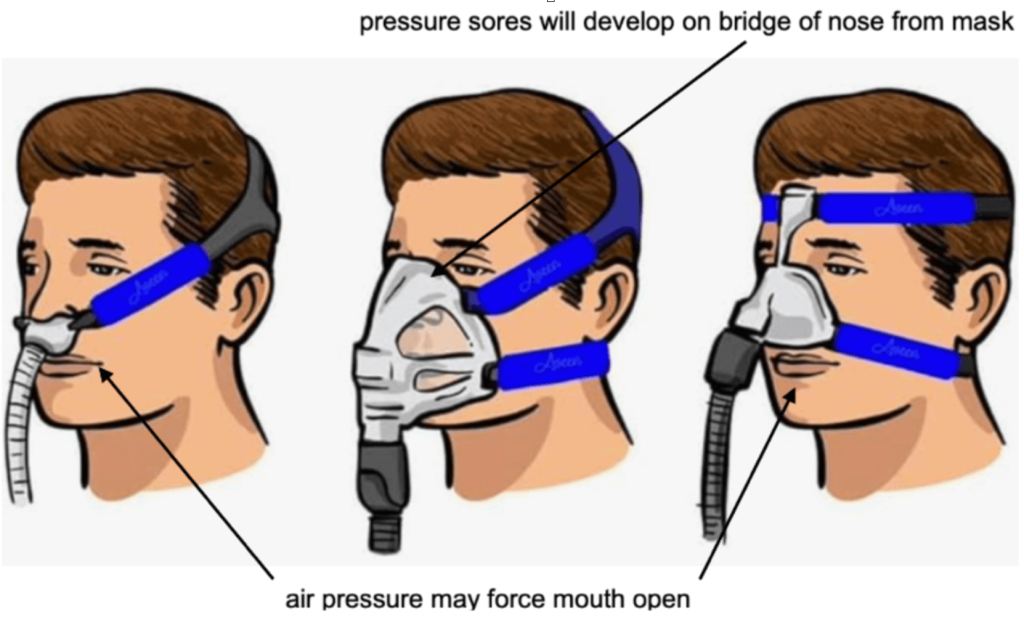
I myself have been through two sleep tests, administered by a neurologist many years ago because of severe migraines. This doctor decided I should be tested for sleep apnea at a sleep clinic instead of just medicating my migraines away. I had to suffer through two poorly-run, poorly-designed sleep studies at what was then called St. Barnabas Hospital in Livingston, NJ. The end result: the doctor prescribed a CPAP machine. The mask only covered my nose, not my mouth. So, every positive blast of air from the machine forced air in through my nose (like it was supposed to), but instead of the air going down into my lungs, the air pressure made my mouth pop open every few minutes all night long. I fired the doctor, returned the machine and found a competent doctor who gave me migraine meds. My sleep tests were stressful, uncomfortable, and difficult, but at least I could get out of bed during the night to use the bathroom. How would an ALS patient, like our son, who was paralyzed, mute, and suffered from anxiety attacks supposed to cope with a sleep study? A sleep test for an ALS patient would be traumatic.
Our son, who died in October 2021 from ALS, tried to get either a CPAP or BiPAP early in his ALS diagnosis (I don’t remember which one), but he was told by a pulmonologist that his breathing performance had to be around 60% or lower first. Why was he supposed to wait until his breathing was severely compromised before he could get a non-invasive machine to help him breathe? Easy answer: because the doctor didn’t understand ALS. Our son found another doctor and got a ventilator instead of either a CPAP or BiPAP without a sleep test.
Definitions
The following is from: https://medictests.com/units/the-mechanics-of-respiration
Respiration
In everyday lingo, “respiration” is simple breathing (the movement of air in and out of the lungs). However, in medical terms, “respiration” is the exchange of oxygen with carbon dioxide inside the alveoli of the lungs. The goal is to expel the CO2 and replace it with fresh air otherwise suffocation will occur. For ALS patients oxygen should NOT be used because the body will see lots of oxygen and not work as hard to expel the CO2. Suffocation due to insufficient oxygen is probably the main killer of ALS victims.
Ventilation
Ventilation is the mechanical inhalation and exhalation of air via breathing, period. This doesn’t mean the exchange of oxygen with carbon dioxide (see below). With just ventilation, the CO2 is still trapped in the lungs.
Oxygenation
Oxygen is dissolved in blood and body fluids; specifically, this is the process of loading oxygen molecules onto hemoglobin molecules in the bloodstream. If one or both lungs are compromised (e.g., because of a collapsed lung, an infected lung, a mucus-filled lung, a lung with aspirated food or drink, a weakened lung, etc.), oxygen cannot get to the blood like it should.
Non-invasive (NIV) Equipment
Equipment that does NOT penetrate the skin or enter the body, even via an existing orifice. It is equipment worn on the body or outside the body, like masks, hearing aids, splints, casts, BiPAP, CPAP, ventilators, etc. See discussion below.
Invasive Equipment
Equipment that goes into the body (through the nose or into the mouth, or other existing orifices, or penetrates the skin of the body, like a needle, or a feeding tube, or a tracheostomy tube. See discussion below.
The Difference Between Respiration and Ventilation
In order to respirate, a patient must have adequate ventilation. However, the reverse is not true. Just because a patient is ventilating (breathing) does not mean respiration (air exchange with carbon dioxide) is occurring. This is because the body’s ability to move air in and out is NOT the same as the body’s ability to absorb oxygen from that air. This commonly happens when blood flow is reduced to the lungs, or the alveoli are filled with fluid (mucus, pneumonia, drowning, aspiration of food and liquids, etc.). In rare cases, internal (cellular) respiration can be disrupted by toxins and certain rare medical conditions, like ALS. In my opinion, any doctor who prescribes oxygen for an ALS patient without first determining whether oxygen is truly required for survival, doesn’t know anything about ALS.
Non-invasive (NIV) Equipment
Breathing exercisers
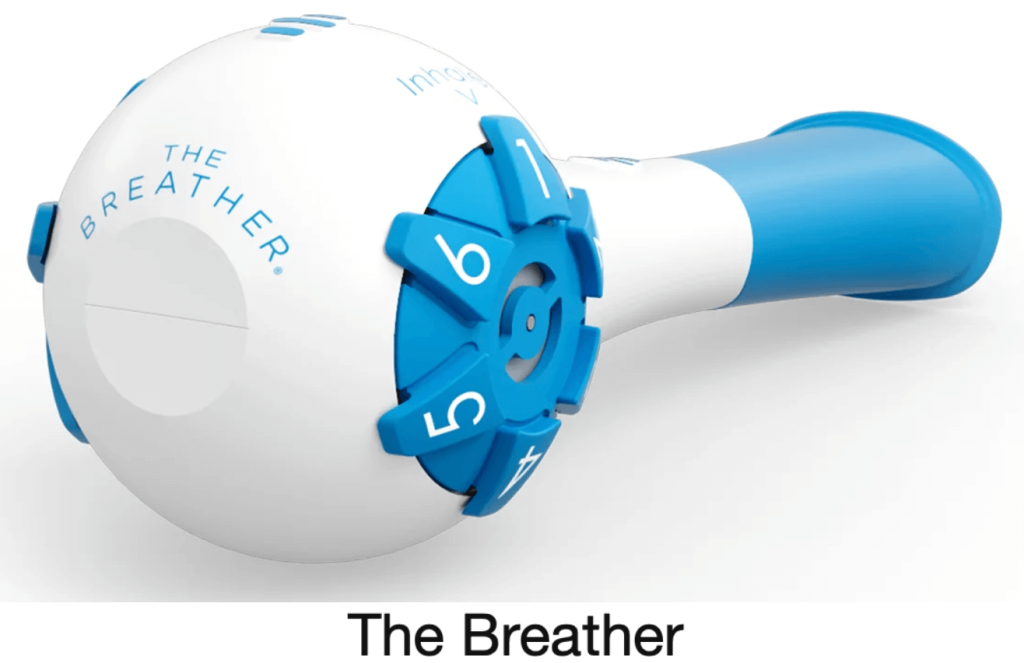
Our son had bought “The Breather” pictured below very early in his ALS illness to try to strengthen his breathing, but he didn’t use it much because he kept getting weaker. It’s supposed to help both inhaling and exhaling. Even though the device was used orally, I would not consider it invasive. Here’s a link to the manufacturer: https://thebreather.com/products/breather. The website offers other models, too.
Ventilators
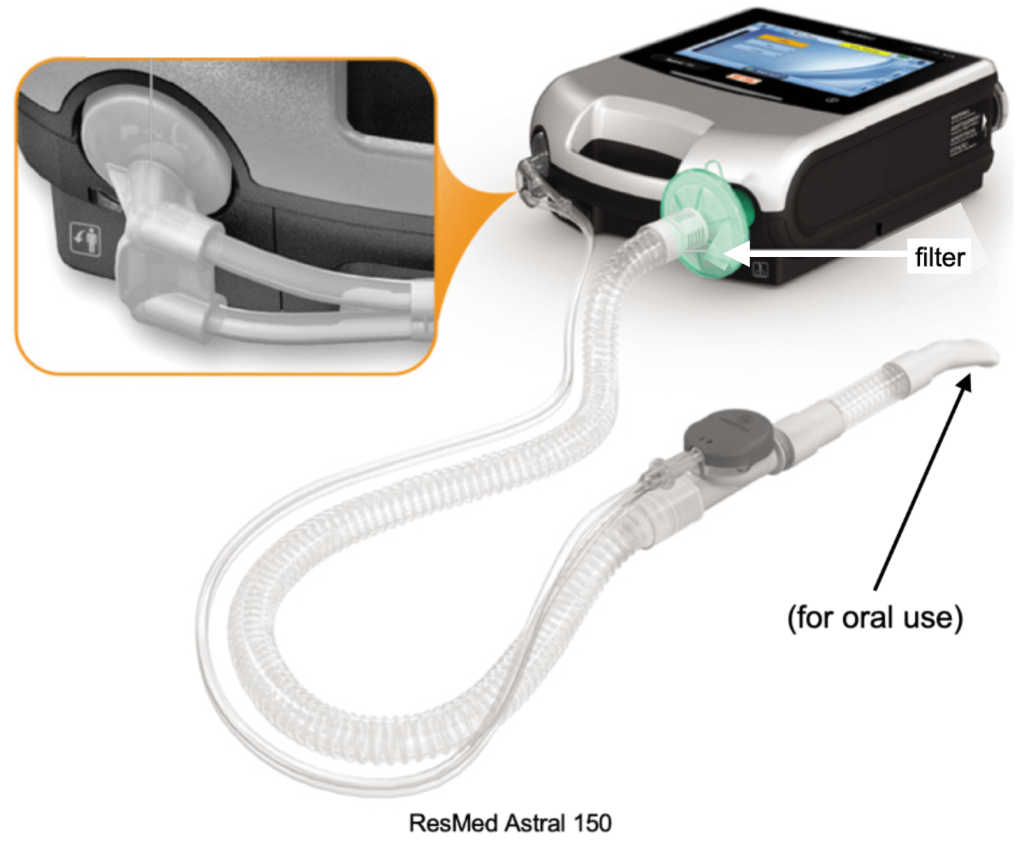
Normal air contains 21% oxygen. Supplementing normal air with pure oxygen to raise the concentration in the bloodstream is not recommended for ALS victims. The excess oxygen will trick an ALS victim’s body into thinking that all the extra oxygen coming from a tank is normal, so the body will slack off. Our son got a ResMed Astral 150, https://www.resmed.com/en-us/ventilation/products/astral/ . See photo below. The white mouthpiece labeled “for oral use” at the end of the hose in the photo is for those who can keep the mouthpiece in their mouths unassisted, or hold it by hand. Our son could not, so we replaced the mouthpiece with a strap-on mask (see the mask photos a few pictures below).
The ventilator above tended to dry out our son’s airway passages and mouth, so he got the humidifier attachment (see picture below) through his DME (“durable medical equipment”) provider, Millennium Respiratory Services, https://millenniumrespiratory.com, (and it was covered by insurance). The humidifier was simple to use: it had an on/off switch and a heater knob that allowed us to adjust humidity. The drawback to the humidifier was that when the room was cool or the humidity setting was too high, water accumulated in the large hose that went to his mask and made a gurgling sound. The ventilator itself had a water detector and alarm to notify us of water buildup, so the alarm began screaming loudly whenever water filled the hose. Because of the “corrugated” shape of the hose, it was never easy to empty, clean, and dry. I had to hang the hose up in our shower stall with no bends, curves or kinks for hours to drain it. Shaking the water out was not easy. The manufacturers could have simply had a drain valve in the hose to empty the water so we didn’t have to stop everything during the night and remove it from my son to drain it.
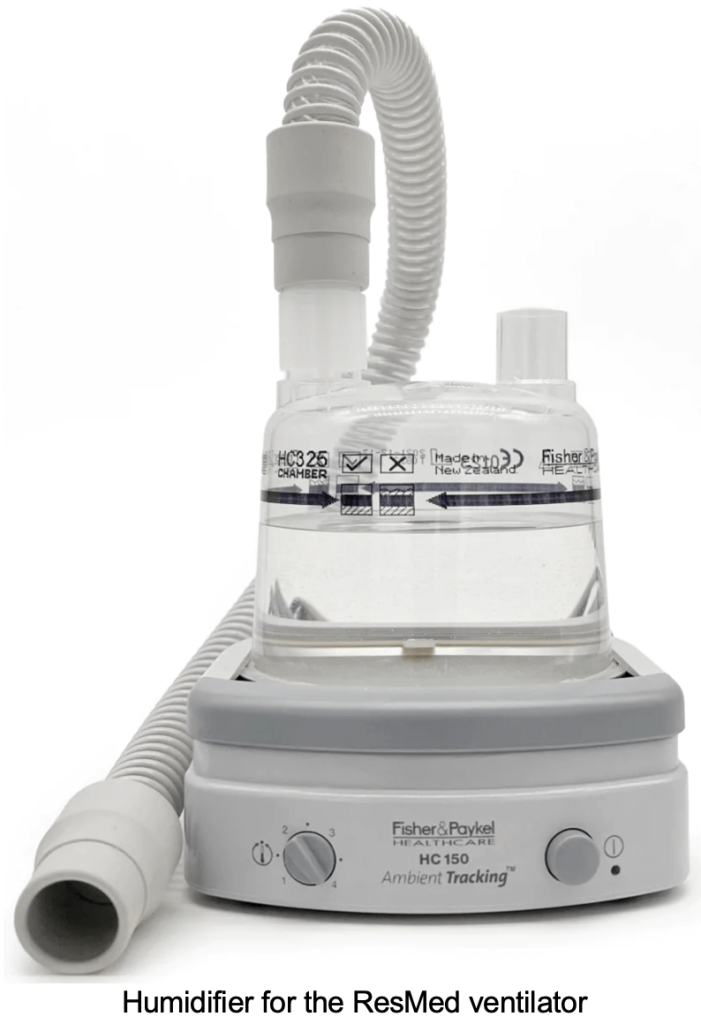
https://www.medicaleshop.com/fisher-and-paykel-heated-respiratory-humidifier-with-ambient-tracking
For cleaning: Besides the hose, we also had to shake out the mask, wipe down everything and hang it up to dry, too. Some parts had to be replaced on a regular schedule through Millennium.
Masks
Mask recall notice
Before I discuss the masks we used, I want to call your attention to the following announcement from the FDA regarding these masks dated 01/31/2023:
“Philips Respironics Recalls Certain Masks for BiPAP, CPAP Machines Due to Safety Issue with Magnets That May Affect Certain Medical Devices”. “The FDA has identified this as a Class I recall, the most serious type of recall. Use of these devices may cause serious injuries or death.”
https://www.fda.gov/medical-devices/medical-device-recalls/philips-respironics-recalls-certain-masks-bipap-cpap-machines-due-safety-issue-magnets-may-affect.
Recalled Product Names:
- Amara View Full Face Mask
- DreamWisp Nasal Mask
- DreamWear Full Face Mask (this was the one our son had)
- Wisp and Wisp Youth Nasal Mask
- Therapy Mask 3100 NC/SP
The recalled masks have straps with powerful magnetic clips instead of hooks to hold them in place. The magnetic clips are pointed out in the middle and right-hand pictures below. Our son originally had a mask like the one in the middle picture, but it had hooks, not magnets. (We found that the magnets were easier to use.)
People who have one or more of the following devices should not wear a mask with magnetic clips. The list includes (but is not limited to):
- Pacemakers
- Implantable cardioverter defibrillators (ICD)
- Neurostimulators
- Magnetic metallic implants/electrodes/valves placed in upper limbs, torso, or higher (that is, neck and head)
- Cerebral spinal fluid (CSF) shunts (such as ventriculo peritoneal (VP) shunt)
- Aneurysm clips
- Embolic coils
- Intracranial aneurysm intravascular flow disruption devices
- Metallic cranial plates, screws, burr hole covers, and bone substitute devices
- Metallic splinters in the eye
- Ocular implants (such as glaucoma implants, retinal implants)
- Certain contact lenses with metal
- Implants to restore hearing or balance that have an implanted magnet (such as cochlear implants, implanted bone conduction hearing devices, and auditory brainstem implants)
- Magnetic denture attachments
- Metallic gastrointestinal clips
- Metallic stents (such as aneurysm, coronary, tracheobronchial, biliary)
- Implantable ports and pumps (such as insulin pumps)
- Hypoglossal nerve stimulators
- Devices labeled as MR (Magnetic Resonance) unsafe
- Magnetic metallic implants not labeled for MR or not evaluated for safety in a magnetic field
What exactly is a full-face mask?
The left-hand photo below shows a true full-face mask: it covers the eyes, nose, and mouth; it truly covers the full face, period. Thank you, U.S. Army. But nobody wants to wear that kind of mask all day long. The middle photo below shows what some vendors, like ResMed, incorrectly call a “full face” mask, but only the nose and mouth are covered. That one should maybe be called a “nose-mouth” mask. The right-hand photo below shows what some vendors, like Philips Respironics, incorrectly call a “full face” mask, but only the nostrils and mouth are covered. Some call this an “under-the-nose” mask, which is better. I think I made my point about what “full” means.
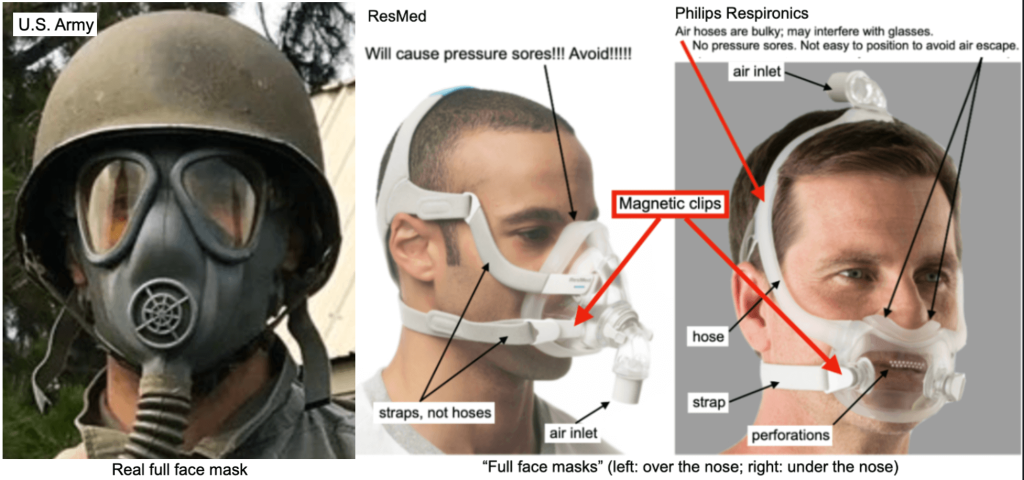
Here are links to the two medical masks in the middle- and right-hand photos above:
Middle photo: https://www.cpapnation.com/products/resmed-airfit-airtouch-f20-full-face-mask-headgear
right photo: https://www.usa.philips.com/c-e/hs/sleep-apnea-therapy/dare-to-dream/full-masks.html
Since our son had to use a face mask instead of the mouthpiece described above, Millennium initially gave us the so-called full-face mask in the middle photo above. Air flowed directly in through the hose at the bottom of the mask. Our son (and many other wearers) got sores on the bridges of their noses because the masks rubbed his skin raw. We began applying special tape on the sore area, but the tape was difficult to handle and the sores kept forming. Doctors always seem to prescribe this mask first. Always. Why? Isn’t there any feedback to them? Maybe they should be forced to wear this kind for a few days. Guaranteed sores. Maybe then they’ll realize the alternative shown in the right-hand picture above is better than the mask in the middle.
We then learned about and replaced the mask in the middle photo with the Philips Respironics DreamWear Full Face Mask (see right-hand photo above). Our son got no sores with the DreamWear mask. The wide, gray flat objects in that picture that come from the hose connector at the top and go down both sides of the guy’s head are actually air tubes. Air flows from the ventilator to the inlet at the top of the wearer’s head, and then passes through the flat tubes on both sides of the wearer’s head.
The ventilator was supposed to be used at least 4 hours a day and also at night to keep the blood oxygenated to at least 95% (measured with a clamp-on finger monitor), but our son couldn’t stand wearing the mask. The mask either hurt, or was wet, or he was uncomfortable, or he had frequent anxiety attacks, etc. He could only tolerate it for maybe 15 minutes. Putting on and wearing the mask while also wearing head support equipment to deal with head drop was extremely difficult. You’ll have to experiment with different masks and strap configurations to find one comfortable for you.
The weird part of the mask issue: all the masks we tried came with perforations in the face pieces (like the right-hand photo above) because they’re really designed for BiPAP/CPAP machines, which I guess needed the perforations. When our son’s respiratory therapist initially came to our house to set up the ventilator and mask, she put tape over the perforations to force all the air to go into his lungs instead of some of it escaping through the perforations. Then one day she told us she was no longer allowed to tape over the holes, but her reason was very vague. So, whenever we got new masks, we taped the holes ourselves, otherwise most of the air just escaped through the perforations.
The under-the-nose mask had to be positioned exactly right or it would not completely seal, thereby allowing the air to leak out around the mask cushion and make farting noises. The noises made our son laugh and disrupted our ability to place the mask. At least there were some lighthearted moments. Countless times the leaking air blew directly into our son’s eyes until we positioned the mask correctly.
What kind of connectors hold the straps to the masks?
In early 2024 I learned of a new Philips “full-face” mask called the “Amara View” which is really an “under-the-nose” mask. (Our son had passed away before this model came out, so he never used it). The advertising is very confusing. The Philips link is https://www.usa.philips.com/c-p/HH1232_02/amara-view-amara-view-full-face-mask. The wording in the URL itself contains “full-face-mask”, but it takes you to a mask called “Amara View Under-the-nose mask”. The collage below shows 8 photos from that same URL and website. The top 4 photos show that the mask has non-magnetic hooks, while the bottom 4 photos show that the mask has magnetic clips. Go try and figure what they’re selling!
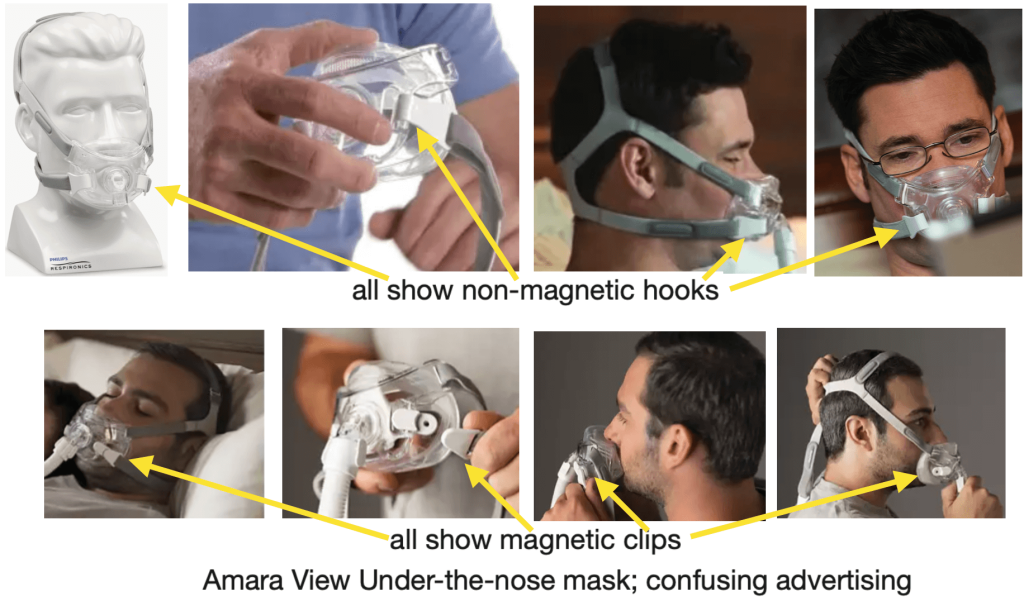
Air enters the Amara View mask through a single round hose connected to the front of the mask, not to the top of the head like the older DreamWear mask I described above.
Our son never wore glasses, so he never had issues seeing or reading with the mask on. It looks like the DreamWear’s bulky left and right flat air tubes might require that the earpieces of the glasses go under the flat air tubes.
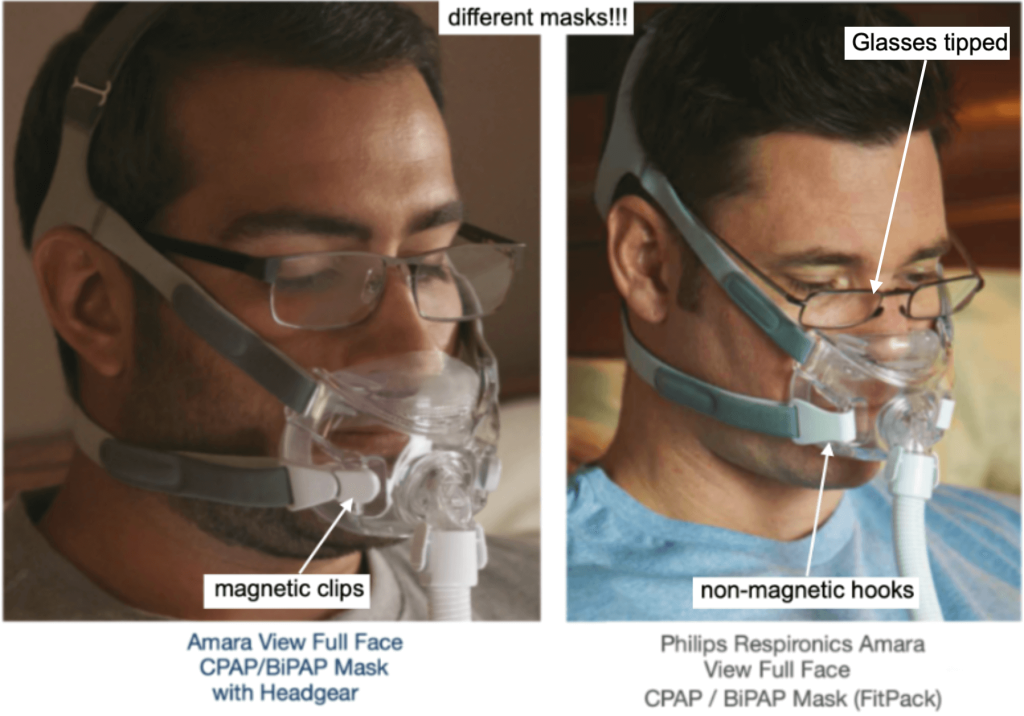
The website for the Philips Amara View Full Face Mask (which doesn’t actually cover the full face) claims that the mask allows “the widest field of vision of all leading full-face masks” (fancy talk meaning the patient can wear glasses). I did find some good photos on two non-Philips websites of two men both wearing glasses AND the Amara View masks (see photos below). In these photos, the mask straps are worn over the earpieces of the patient’s glasses. That doesn’t look too comfortable. The glasses on the guy on the right are obviously tipped down, probably due to the straps interfering with the earpieces.
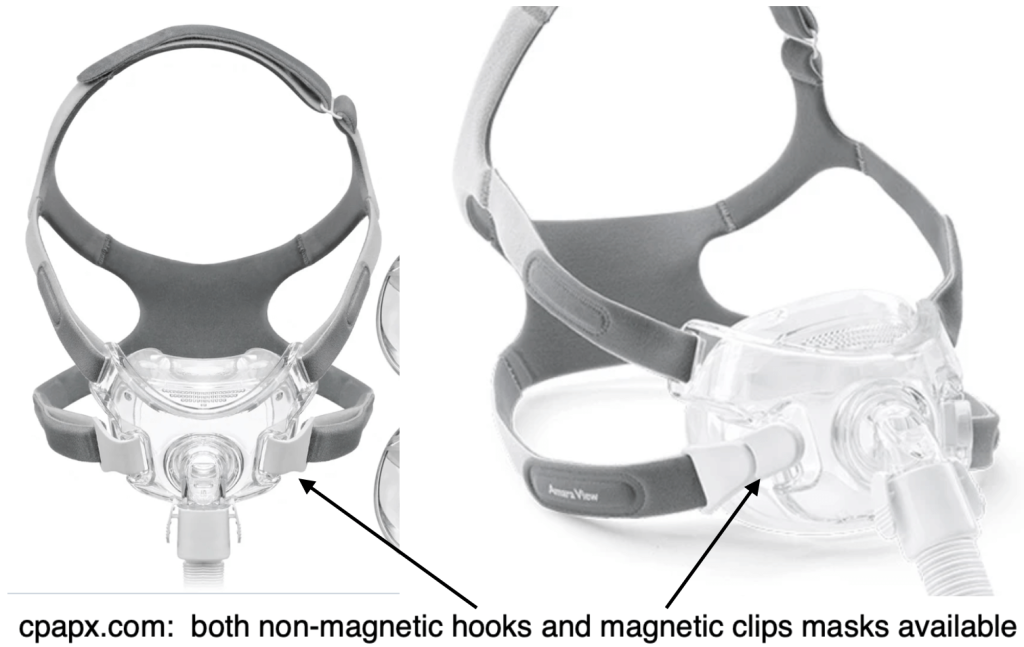
Look at the left photo below from https://cpapx.com/products/amara-view-cpap-bipap-mask-respironics-full-face. Far down on this website page the description says: “Quick release Magnetic Headgear Clips or Soft plastic Talon Clips for people who prefer to, or can’t, use magnets.” It gives pictures (see below) of both versions. At least this website mentioned the different versions.
Look at the right photo above from (https://www.cpapstorelosangeles.com/product/philips-respironics-amara-view-full-face-cpap-bipap-mask-fitpack/. The two masks have different connectors. Very strange: this website gives two pictures side-by-side (See below) of the same guy wearing two different masks, even though both pictures are supposedly advertising the same Philips Respironics Amara View Full Face CPAP / BiPAP Mask -FitPack. The mask in the left-hand photo has non-magnetic hooks, while the mask in the right-hand photo has magnetic clips. The ad itself states that this mask comes with magnetic clips, so the left-hand mask isn’t mentioned at all.
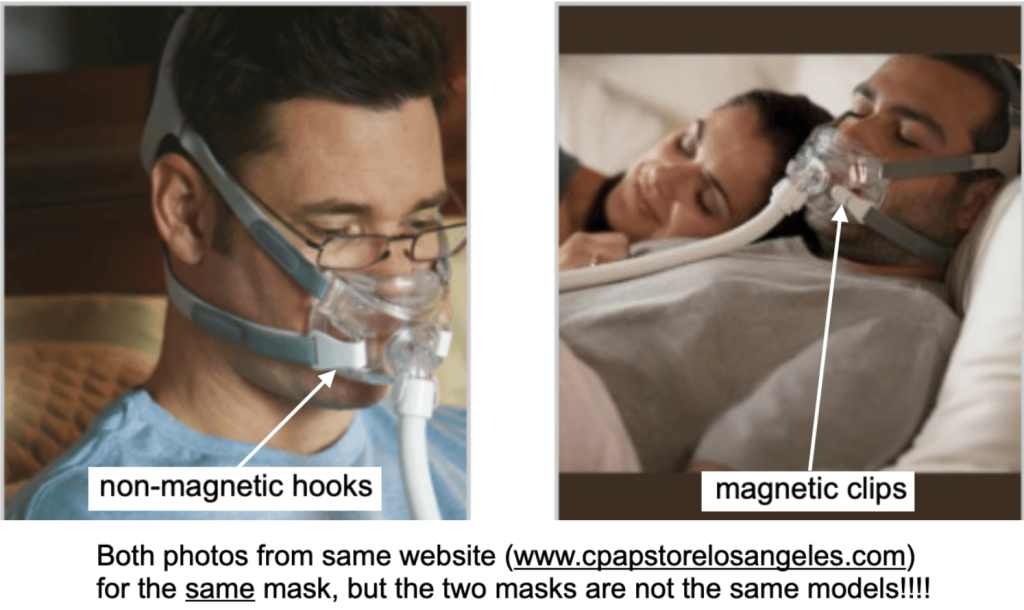
Regardless of the discrepancies in the photos, the masks with magnetic clips have been recalled, but they are still available on the web. Lesson: make sure you know what you’re getting.
Some other mask versions are shown below.
https://www.amazon.com/4-packs-covers-comfort-comfort-comfortaable-supplies/dp/B08598N6S8
VOCSN
The VOCSN is a Ventilator, Oxygen source, Cough assist, Suction device, and Nebulizer 5-in-1 device. See photo below.
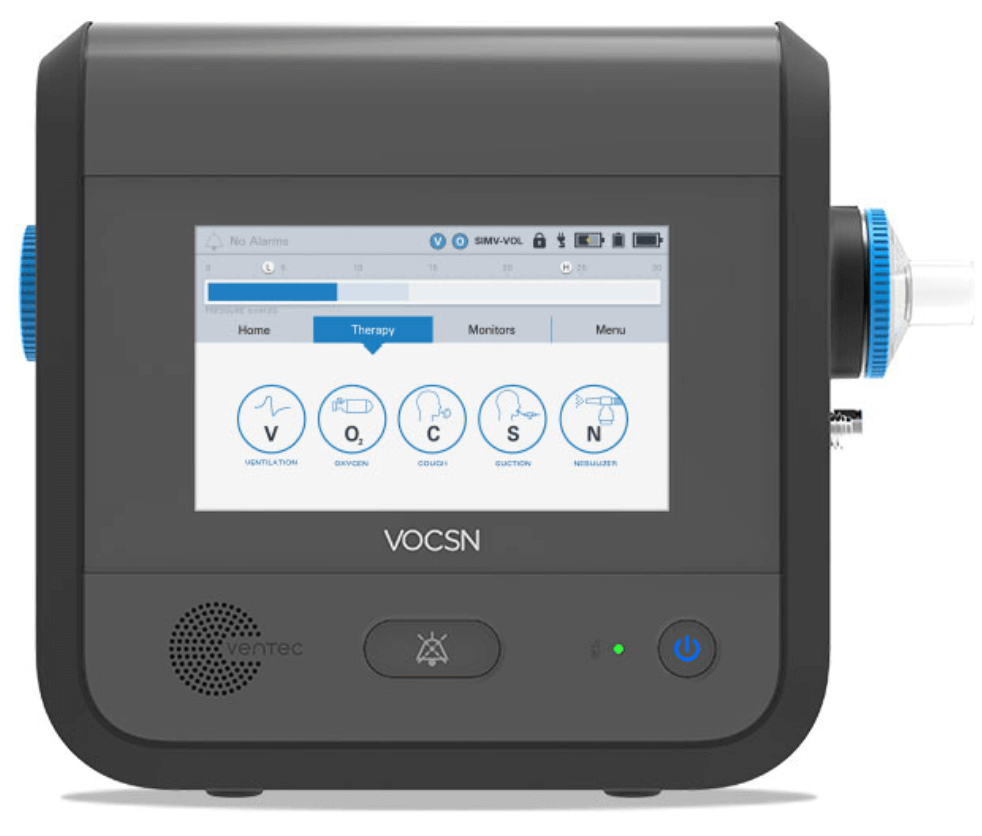
(Note: Only the Ventilator and Oxygen functions in the VOCSN assist with breathing; the other three functions are for dealing with mucus and secretions. We had separate machines for suction, cough assist, ventilation, and nebulizer. Our son never used oxygen until the end of his life. The Millennium rep one day asked if our son (meaning WE) would like to try a VOCSN machine (on loan) because all the functions were in one device. We tried it but returned it after only one day because it was a pain to use. Because we had to deal with our son’s frequent mucus, we always had to have our cough assist AND suction device running at the same time so we could switch back and forth quickly and frequently. However, with the VOCSN, we could only have one function running at a time. If we were using, let’s say, the cough assist function, but then needed the suction function, we had to go to the VOCSN touch screen, turn off the cough assist, switch to the suction function, wait for it to start, do some suction, then go back to the screen and switch back to the cough assist function, repeatedly. We had to change the associated hoses and equipment, too. We never even tried the ventilator or nebulizer functions. We returned the VOCSN.
CPAP (Continuous Positive Airway Pressure)
The CPAP only provides oxygenation from ambient air, not oxygen from a tank.
(From https://www.nhlbi.nih.gov/health/cpap)
“Continuous positive airway pressure” means a device pushes air at a higher pressure into your airway, which includes your nose, mouth and windpipe (trachea). That higher pressure keeps your airway open and can help move air into and out of your lungs. A CPAP machine uses mild air pressure to keep breathing airways open while you sleep.
How does CPAP work?
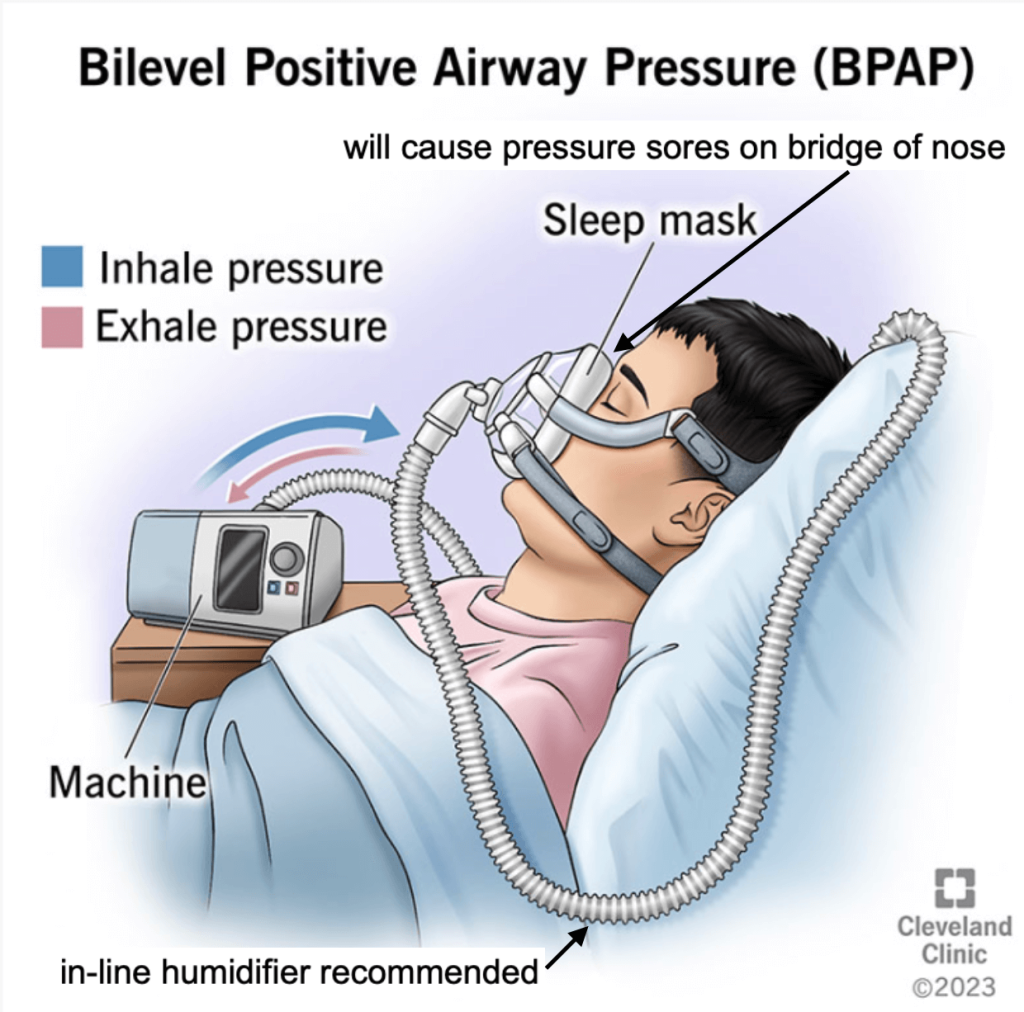
You should use your CPAP machine every time you sleep at home, while traveling, and during naps. Getting used to your CPAP machine takes time and requires patience. Your healthcare provider will work with you to find the most comfortable mask that works best for you (see some issues in the picture below). From our son’s experience, and also what I’ve seen on the Facebook caregivers/patients group, doctors are clueless about masks and will prescribe masks that rub on the bridge of the nose and cause pressure sores. The caregivers and patients then waste valuable time and money trying to alleviate the bridge pressure and treat the open sores when the simple solution is to get an under-the-nose mask. You may also need help from your healthcare provider to use the humidifier chamber in your machine (if so equipped) or to adjust your pressure settings. You may also need to try a different machine that has multiple or auto-adjusting pressure settings. For the treatment to continue to work, it is important that you clean your mask and tube every day and refill your medical device prescription at the right time to replace the mask and tube.
What are the benefits of CPAP?
You may notice immediate improvements after starting CPAP treatment, such as better sleep quality, reduction or elimination of snoring, and less daytime sleepiness.
Equally important are the long-term benefits of CPAP, which include: helping to prevent or control high blood pressure, lowering your risk for stroke, and improving memory and other cognitive functions.
What are the possible side effects of CPAP?
Side effects of CPAP treatment may include congestion, runny nose, dry mouth, or nosebleeds. Some masks can cause pressure sores on the bridge of the nose. An “under-the-nose” mask will avoid sores on the bridge of the nose. Your healthcare provider can help you find ways to relieve these symptoms and adjust to using your CPAP machine. If you experience stomach discomfort or bloating, you should stop using your CPAP machine and call your healthcare provider right away.
Is CPAP covered by insurance?
If your healthcare provider prescribes CPAP, your insurance will work with a medical device company (a Durable Medical Equipment” provider, or “DME”) to provide you with a CPAP machine, plus the mask, tube, and humidifier. The DME is an unfortunate nuisance of an industry that has inserted itself between you (the customer) and the manufacturer because some manufacturers won’t sell directly to the end user. The DME is just a middleman and tacks on costs to the equipment.
Your provider will set up your machine with certain pressure settings. After using your machine for a while, your provider and possibly your insurance company will want to check the data card from your machine to confirm that you are using your CPAP device and to see if the machine and its pressure settings are working to reduce or eliminate apnea events while you sleep.
BiPAP (Bilevel Positive Airway Pressure)
“Insurance companies do not usually require ALS patients to do a sleep study to qualify for a BiPAP.“ This statement is taken from a good and thorough discussion about the BiPAP machine at https://www.youralsguide.com/bilevel-bipap-sleep-therapy.html. In my opinion, if your pulmonologist insists on a sleep study for an ALS sufferer, that doctor doesn’t know ALS and you should find someone else.
Our son couldn’t lie down at all because he claimed that when he tilted back even slightly, his lower jaw pressed against his trachea and he began to choke. ALS sufferers also cannot expel oxygen from their lungs. The BiPAP simply forces air down into the lungs.
The BiPAP provides ventilation AND oxygenation, but not oxygen.
BiPAP offers two pressure settings. BiPAP machines can automatically switch between a higher inhalation pressure and a lower exhalation pressure. Good for asthma, or COPD (Chronic obstructive pulmonary disease). See the link for more information on BiPAP (from https://my.clevelandclinic.org/health/treatments/24970-bipap). See diagram below, with my comments and suggestions.
Here is a link to a discussion about 4 different non-invasive breathing machines:
https://www.sleepdr.com/the-sleep-blog/what-is-a-cpap-machine-difference-between-cpap-apap-bipap-and-asv/
Here is a good video about masks, but the person doesn’t talk about ALS and breathing.
https://www.youtube.com/watch?v=re1Gopc8mCI
Here’s some info about NIV, CPAP, BiPAP:
https://respiratory-therapy.com/public-health/healthcare-policy/home-care/niv-bipap-cpap-why-terminology-matters
Here’s a detailed explanation of the various breathing technologies, including some I never heard of:
https://cpapsupply.ca/resources/apap-vs-bipap-vs-cpap/
Hayek BCV
I don’t have any experience with this device, but someone mentioned it on the ALS Facebook group, so I’ve included some information about it in this article. Some links are at the end of this section.
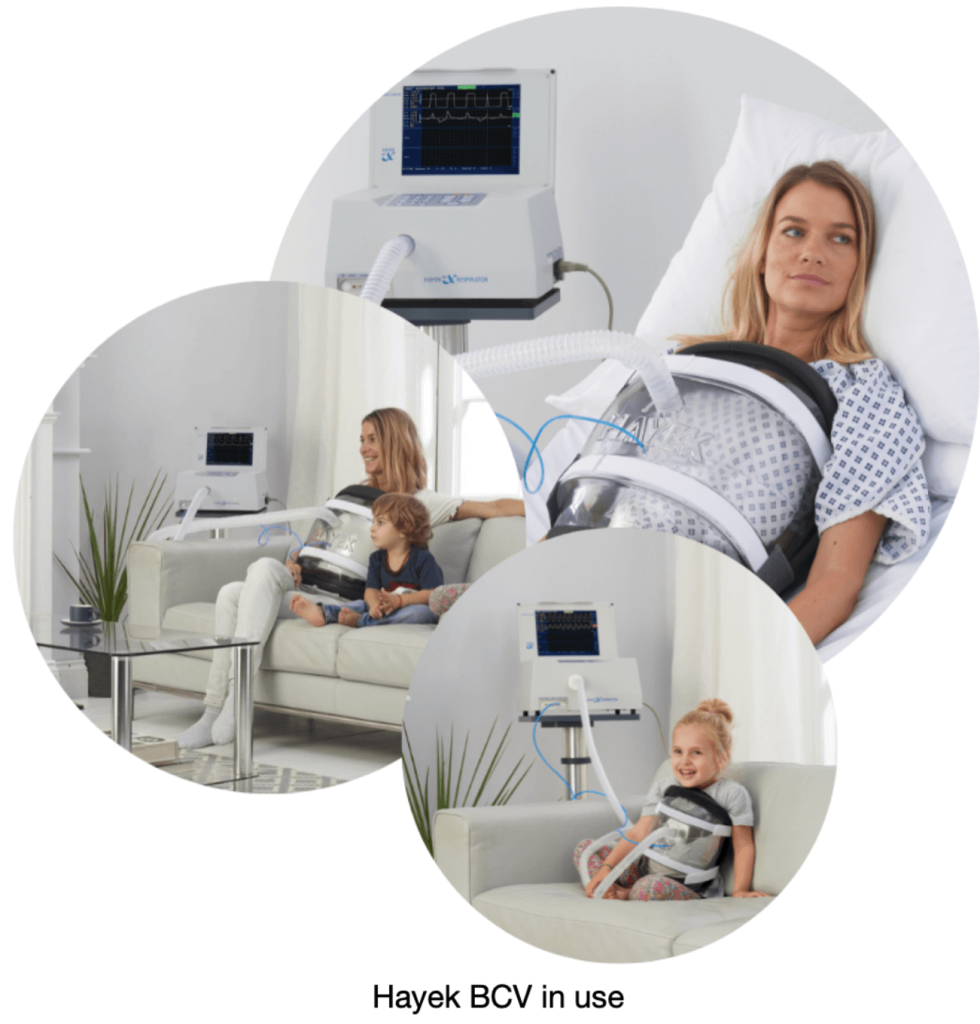
The Hayek BCV (Biphasic Cuirass Ventilation) (see photo below) is a noninvasive ventilator. You just strap in on. BCV delivers negative pressure ventilation (NPV), controlled ventilation (BCV), sync ventilation, high frequency chest wall oscillation (HFCWO) and cough support for adult and pediatric patients. (See photo below.)

The person who posted about the device said it does not cause bloating, nor push air in the stomach like the face masks sometimes do, nor does it increase mucus, cause dry sinuses, or throat and skin irritation, etc. The vendors claim it can assist those that have either a chronic or acute need for respiratory assistance. Our son, who died from ALS in October 2021, hated wearing his so-called “full face” under-the-nose mask, so I think one of the most interesting features of the Hayek is that it is not worn on the face at all.
I don’t know if there are any unpleasantries or side effects from wearing this on the front of the torso, e.g., tightness, sweating, pressure sores, etc. How does it fit if you’re overweight and underweight? If you have head drop and want to try out one of those bulky, useless head/neck supports, will the top edge of the Hayek get in the way? Because ALS had destroyed all our son’s muscles, he could not sit up; he had a terrible slouch. There’s no way the Hayek could have been strapped to his torso. How much air leaks in or out around the seal to your torso? How do you travel with it while it’s in operation? On a cold day, how do you get a coat on over it? Will it seal properly to your torso if you’re wearing a heavy sweater? What do you do if you have to use the toilet? If you need a sling or a SureHands metal patient frame hanging from a ceiling lift or rolling patient lift to transfer you, does the Hayek have to be removed? Can you wear it while in a power chair? What about needing it while showering? Can you lean forward with it on? How do you move around with it in operation?
The three photos below show people (actual patients?) wearing the Hayek.
If you are interested in the Hayek, please find users who can talk to you about its pros and cons, and ask the vendor about the issues I raised.
Some links to the device:
Invasive equipment
Here is a link to Invasive ventilation:
https://www.osmosis.org/learn/Respiratory:_Mechanical_ventilation
Two methods are mentioned: endotracheal and tracheostomy. Note: a tracheotomy is a medical procedure; a tracheostomy is the actual opening. Our son had the tracheotomy, followed by the tracheostomy.
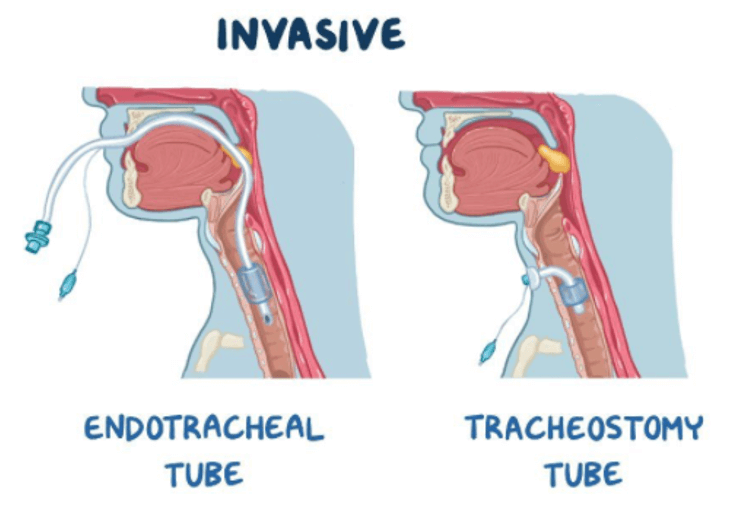
We had only two weeks of experience with our son’s tracheostomy before he passed away. I know the patient will need 24/7 monitoring and care once is placed.
Here is a text written by Jan Steinbock in Feb 2024 on the Facebook group “ALS – Patient and Caregiver tips for every day living” about the tracheostomy she has. She is an ALS victim and regular contributor to the ALS Facebook group. I think she got this information from the ALSA.org website.
“A WORD ABOUT OXYGEN
We talk about low levels of oxygen in ALS, especially at night, and the body’s natural mechanisms for maintaining normal oxygen levels during the day (by having you breathe faster or your heart beating more rapidly). So you would think that providing supplemental oxygen through a small tube into the nose would do the trick. Sadly, it is not so simple.
In the absence of a lung disease that affects your air sacs (alveoli), the reason for decreased oxygen levels in ALS is lung muscle weakness. If you breathe shallowly, you are not able to exchange air and get rid of carbon dioxide effectively. Rising carbon dioxide levels replace oxygen and impair access to adequate levels of oxygen from the air around you.
That is why the treatment for shallow breathing (and its resulting decreased oxygen) is to give you a bigger breath, through bi-level noninvasive positive pressure breathing at night and breath stacking, mouthpiece ventilation, or manual or mechanical sigh breaths during the day, as needed. This way oxygen, a component of the air we breathe, will find its way to all areas of the lungs, especially the smallest bronchioles and air sacs at the bottom and sides of the lungs.
Lastly, oxygen is classified as a medical gas and is regulated by government agencies. Like any medication, physicians must document a physiological need for it, show it is not harmful, and demonstrate benefit. In ALS, oxygen administration may be detrimental if it is used in place of bi-level positive pressure breathing support. Normally, your body takes high levels of carbon dioxide as a signal to initiate a breath.
Over time, if you have gotten used to higher-than-normal levels of carbon dioxide in your lungs and blood stream, your body may rely on a low level of oxygen to know when to take a breath. Supplemental oxygen may get rid of this signal for breathing and result in impaired breathing. The result can be profound sleepiness, and lack of clear thinking or disorientation. Make sure those who suggest and prescribe oxygen are very knowledgeable about ALS and familiar with guidelines for safe and effective treatment.”
Tracheostomy, CO2 and ventilator
You can have a ventilator without a tracheostomy. The ventilator is supposed to push air into your lungs so you can expel CO2. Our son began having breathing difficulties around 10/12/21, so an ambulance took him to the ER and he had a trache put in 10/19/21. He was miserable after that. He had a lung infection, and a collapsed lung, and it had mucus in it. The staff began giving him 100% O2 through his trache until his vitals were good. Then they began lowering the O2 to wean him from O2. They got his oxygen demand down to 40%, but couldn’t go further. This showed that he could not have breathed regular air on his own ever again. He was so miserable that he begged to die, but we didn’t want to lose him. After two and a half miserable weeks in the hospital, I told his doctor that our son didn’t want to live. The hospital staff began the hospice process: large morphine doses through his IV, plus they replaced the O2 feed with regular air, which was insufficient for him. He went to sleep and passed away about 1 – 2 hours later.
Lastly
Go to a doctor who knows ALS!!!!
One member of the Facebook group “ALS – Patient and Caregiver tips for every day living” wrote in to tell the members that her husband (the ALS victim) was having breathing difficulties. She then said that since the nearest ALS clinic was 2 hours away, she took her husband to a pulmonologist who obviously had no idea about ALS. The doctor ran breathing tests, did blood work, and conducted a sleep study test on the poor guy overnight. The doctor’s office reported back to the wife that her husband had sleep apnea and they wanted him to have a second sleep study with his CPAP mask on. NO!!! Go to the right doctor!!
